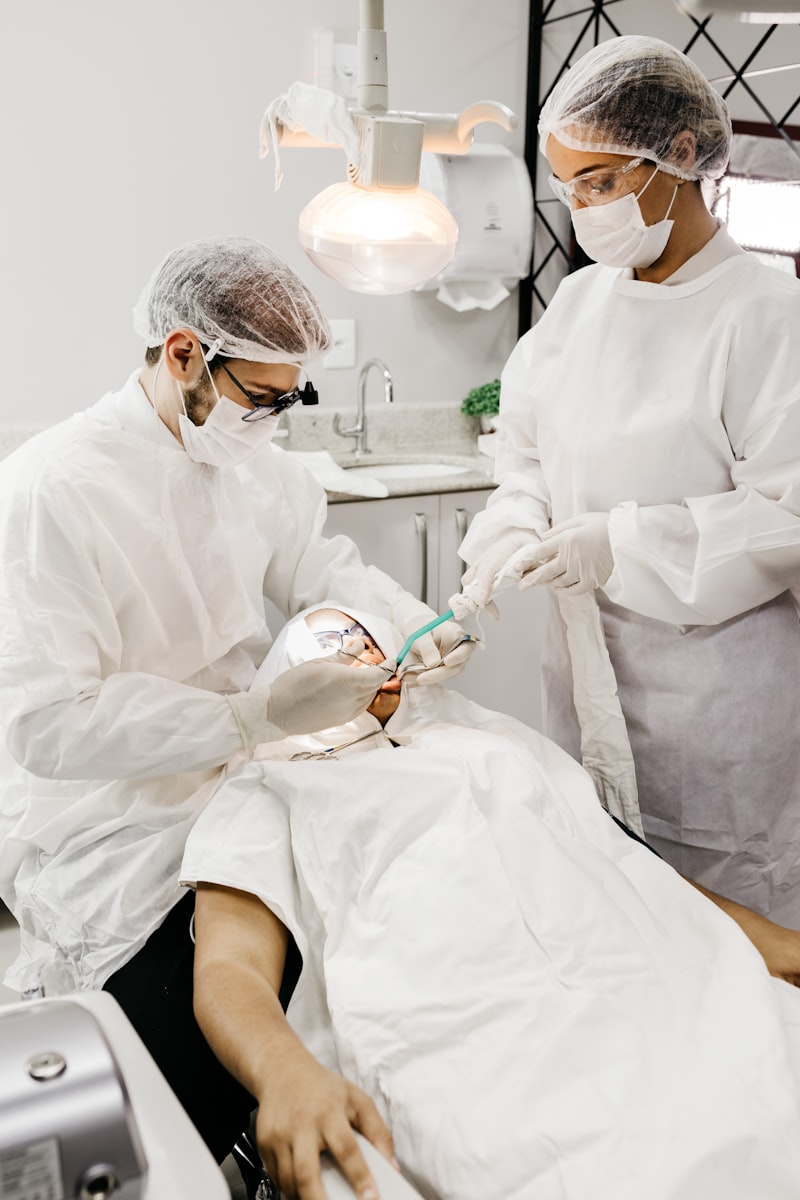
Let me be honest: of all the patients I treat, most only come in after enduring pain for days or weeks. When asked why they didn't come sooner, the answer is almost always the same: "I was scared, Doctor." I wrote this article specifically to change that perception.
Why Doesn't a Deep Cavity Have to Mean Extraction?
There is a deeply rooted assumption in society: a tooth that hurts badly must be pulled. This is often wrong. As long as the tooth root and supporting bone are still healthy, a tooth that seems "dead" can still be saved through Root Canal Treatment (RCT) — known in Indonesia as PSA (Perawatan Saluran Akar).
What Is Root Canal Treatment?
RCT is a procedure to save a tooth whose pulp (the living tissue inside the tooth) has become infected or died due to deep decay, cracks, or trauma. The procedure consists of:
- Local anaesthesia — ensuring the entire procedure is completely painless
- Opening access to the pulp chamber
- Removing the infected pulp tissue using extremely fine root canal files
- Cleaning and shaping the root canals with antiseptic irrigation
- Filling the root canals with biocompatible material (gutta-percha)
- Crown restoration — usually with a crown to protect the now more fragile tooth
This process typically requires 2–3 visits depending on the degree of infection. With modern rotary file technology and apex locators (devices that measure root canal length electronically), the precision and comfort of the procedure have improved enormously compared to 10–15 years ago.
Root Canal vs Extraction: The Long-Term Consequences
Many patients think pulling a tooth is the cheaper "one-and-done" solution. But there are long-term consequences that often go unmentioned:
| Root Canal + Crown | Extraction | |
|---|---|---|
| Keeps the natural tooth | Yes ✓ | No ✗ |
| Chewing function | Normal | Reduced if not replaced |
| Shifting of neighbouring teeth | Does not occur | Teeth shift within 6–12 months |
| Alveolar bone resorption | Does not occur | Occurs — the bone shrinks permanently |
| Long-term cost | Higher upfront, but no implant/bridge costs | Cheap upfront, but replacement (implant/bridge) is expensive |
| Durability | 10–15 years or more with good care | Implants or dentures need maintenance and replacement |
A natural tooth, even if "non-vital" after a root canal, is always superior to any replacement — because it still has the periodontal ligament that keeps the surrounding bone healthy.
Wisdom Tooth (Impaction) Myths: Facts vs Fear
Wisdom teeth (third molars) that grow at an angle or remain buried (impacted) do often need removal — but it is not a procedure to fear.
Myth: "Wisdom tooth extraction is extremely painful and takes a long time to heal."
The fact: With proper local anaesthesia, the procedure itself is completely painless. While the anaesthetic is active, patients feel only pressure, not pain. Post-extraction discomfort can usually be managed well with standard analgesics during the first 2–3 days.
Complications such as dry socket (alveolar osteitis) can be minimised with proper post-operative instructions: no vigorous rinsing for 24 hours, no smoking, and no drinking through a straw.
Modern Local Anaesthesia: Not as Painful as You Imagine
Patients' greatest fear is often not the procedure itself, but the anaesthetic needle. Allow me to explain a few things:
- Topical anaesthetic is applied to the gums a few minutes before the injection — making the sensation of the injection itself very minimal
- Modern dental needles are very thin (27–30 gauge) compared to general medical needles
- A slow, controlled injection technique drastically reduces pressure and discomfort
- For highly anxious patients, oral sedation (anxiolytics) is available with a doctor's approval
The principle I always hold: patients must never feel pain during any procedure. If anything feels uncomfortable, simply signal and we will add more anaesthetic. There is no reason to "endure the pain."
Scaling: Not Just About Bad Breath
Scaling (professional tartar cleaning) is the most underestimated procedure — yet possibly the most important for long-term health.
Tartar (calculus) is bacterial plaque that has hardened and cannot be removed with a regular toothbrush — only a dentist can clean it. Without routine scaling, here is what happens:
- Gingivitis (gum inflammation): Red, swollen gums that bleed easily when brushing
- Periodontitis: The infection spreads to the alveolar bone beneath the gums
- Loss of tooth-supporting bone: The bone shrinks → teeth become loose
- Permanent tooth loss: In advanced cases, teeth fall out not from decay, but from loss of bone support
I recommend scaling every 6 months for most patients — more often (every 3–4 months) for patients with active periodontitis or smokers.
"Fear of the dentist is something I understand deeply. But that fear pays off far better when you come early. Filling a small cavity needs no anaesthesia; treating a severely infected tooth is far more complex. An investment of 30 minutes every 6 months can save you years of expensive treatment down the road."
— drg. Andreas Wijaya, M.KG