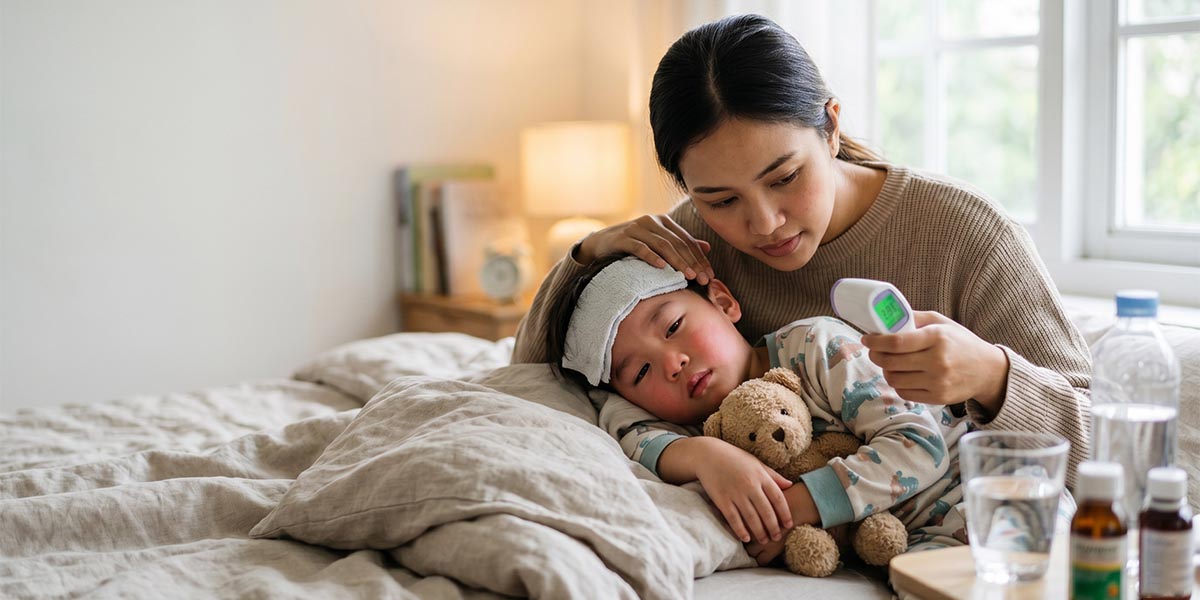
The question I receive most often from parents at night: "Doctor, my child has a fever of 38.5°C. Do we need to go to the ER now, or can we wait until morning?" The answer is not as simple as the number on the thermometer. Let me explain how to read this situation correctly.
What Is a Fever?
Fever is not the enemy. Fever is the natural response of the immune system when a child is fighting an infection — bacteria, viruses, or other pathogens. The elevated body temperature actually helps the immune system work more effectively.
A temperature is considered a fever if:
- ≥38°C measured rectally — the most accurate standard for babies <3 months
- ≥37.5°C measured axillary (armpit) — more practical for older children
- ≥38.5°C measured orally (mouth) — for children >5 years
First Aid for Fever at Home
- Give the right antipyretic. Paracetamol 10–15 mg/kg body weight per dose, every 4–6 hours. Ibuprofen can be given to children >6 months (5–10 mg/kg), but avoid it if the child is dehydrated or has an empty stomach.
- Ensure adequate fluids. Fever increases the body's fluid needs. Breastfeed more often for babies; give water or oral rehydration solution for older children.
- Comfortable clothing. Remove layered clothing. A warm compress (not cold or ice) on the forehead, armpits, and groin folds helps release heat.
- Monitor for danger signs every 2–4 hours. Don't just sleep and hope the fever goes down on its own.
🚨 Emergency Signs: Go Straight to the ER
The following conditions require immediate evaluation in the emergency department, regardless of the thermometer reading:
- Baby <3 months with a temperature ≥38°C — this is always an emergency, no exceptions!
- Seizure (febrile convulsion) lasting >5 minutes, or occurring more than once
- Child appears very weak, won't wake up, or doesn't respond when called
- Purplish-red rash (petechiae/purpura) that doesn't fade when pressed with a finger
- Stiff neck or extreme sensitivity to bright light
- Difficulty breathing, very rapid breathing, or flaring nostrils
- Refusing to drink at all for >8 hours, or signs of severe dehydration (no urination >8 hours, deeply sunken eyes, crying without tears)
- Fever >40°C that doesn't come down after a correctly dosed antipyretic
- Fever lasting >5 consecutive days without improvement
It Can Wait — Consult in the Morning
If your child has a fever but is still active, still drinking, has none of the emergency signs above, and the temperature drops after an antipyretic — you can wait and consult a doctor during practice hours. Keep monitoring every 2–4 hours.
How to Tell a Common Cold, Allergies, and Asthma Apart
Many parents assume their child gets colds often because of a weak immune system, when in fact there may be an overlooked allergy component:
- Common cold: Mucus starts clear then turns yellow/green, usually with a mild fever, lasts 7–10 days.
- Allergies: Continuously clear mucus, sneezing, itchy eyes, without fever, worsens when exposed to allergens (dust, animal dander).
- Asthma: Coughing mainly at night/early morning or after physical activity, wheezing, chest feels tight. Requires spirometry evaluation and specialised management.
The First Aid Kit Every Home Must Have
I always advise parents to prepare this before their child gets sick, not after panicking in the middle of the night:
- Digital thermometer (rectal for babies <3 months)
- Paracetamol syrup dosed to your child's weight
- Ibuprofen syrup (for children >6 months)
- Oral rehydration salts (electrolyte solution to prevent dehydration)
- Plasters, sterile gauze, and wound antiseptic
- Saline nasal drops (for a blocked nose)
Just as important: save your paediatrician's contact number and the nearest ER number in your phone now, before an emergency happens.